Showing posts with label book study. Show all posts

Tuesday, June 11, 2013

Talking, Drawing, Writing Book Study {Chpt 1}

Better late than never.  Right???

I am reading the book "Talking, Drawing, Writing" by Martha Horn & Mary Ellen Giacobbe.  I am a second grade teacher and this book is clearly written for a kindergarten/first grade classroom.  However, I am wanting to improve my writing instruction and this seems like a good place to start. 

Jennifer with Teaching With Grace is hosting a book study with this book and I am fortunate enough to get to participate.  The challenge for me is how to adapt this for my classroom.


Chapter 1:  Storytelling

This one seems so easy.  All children love to tell stories.  They come in telling you of things that has happened in their life, things they have seen.  Children even love to make up stories, and tell tales.  Children have an imagination, it is time we let them use it more.  The authors gives the following suggestions:

Tell Oral Stories First:  Students must be able to tell a story before they even begin to write. Students can tell a partner their story and the partner can listen to see if the story makes sense.  At the beginning of the year guidelines would need to be established so that students would be an active listener. 

Share Your Stories:  Teachers are also storytellers!   Share your stories with the students.  Use this time to model how to tell a story.  Next year I may even have a fellow teacher come in and model with our class on telling stories with a partner.   

Time for Storytelling:  Give students time for storytelling.  Give students opportunities for practice.

Follow along with the book study that Jennifer is hosting.  I will be posting my thoughts on each chapter.  I will be catching up with the book study over the next few days!


Wednesday, May 29, 2013

Summer Reading

Happy Wednesday Everyone!
With school being out for summer we all have numerous projects we want to complete in and around our homes.  However, I also want to carve out some time to do some professional reading.  There are a couple of book studies that have caught by attention.  
 
Jennifer from Teaching with Grace is hosting a book study with the book Talking, Drawing and Writing by Martha Horn and Mary Ellen Giacobbe.  I have decided to participate in this book study because writing is going to be a focus for my entire school.  I am aware that this book is target for early elementary, however, I am hoping after reading the book I am able to adapt many of the ideas for my second grade class. 
 
 
For more information about this book study please visit Jennefer's blog.  She has listed the dates each chapter will be discussed. 
 
Best Practice 4 Teaching or Charts & Chit Chat will be hosting a book study on Reading Without Limits by Maddie Witter.  Be sure to check out her blog becuase she will be posting updates about the book study this week.  I am interested in reading this book in hopes of improving my reading instruction.


I was thinking of trying to read three book this summer.  I have found one about writing and one focusing on reading.  Does anyone know of a math book study?

Thursday, July 5, 2012

Guided Math Book Study {Chapter 6}


The chapter begins with the question, What is Math Workshop?

Laney Sammons writes on page 185 “In general, Math Workshop is designed to build on each student’s strengths and needs”.  During math workshop students are able to work collaboratively to “encounter tasks that not only encourage the development of conceptual understanding, but also the work habits that will lead to their future success.”  During this time the teacher can work in small groups with other students.

Followed by Challenges of Math Workshop

It takes time to plan and implement math workshop.  In my opinion, my workshop should be planned the same way you would you reading workshop.  All procedures and routines should be practiced and model prior to full implementations.

The chapter now focuses on nine best tasks for Math Workshop.   

See figure 6.1 on pages 188-189 for a chart of math workshop components.  All math workshop components should have been taught and modeled so the students can work independently.

  • Review previously mastered concepts-- allows students to maintain what they have previously learned.  Basically children are review skills that have already been taught.  Before you add anything to your math workshops model what is expected and practiced.
  • Practice for math fact automaticity—students work in pairs to practice math facts using flash cards, games, computers, etc…  There are a variety of items for purchase or free for your students to use.  I use flashcards cards from Dollar Tree or Target Dollar spot.  I store them in recycled lunch meat containers.  This is the first thing the students work on in math workshop. 
  •  Use mathematical games to reinforce concepts—Students should have been taught to play the game before it enters math workshop.  The games you choose from math workshop should match your curriculum.
  • Practice problem solving— The author discuss using problem of the day or problem of the week at this work station.  She gives suggestions on how to pick out your problem so that it is appropriate for the students.  She also discusses how to model this before you have students work independently. 
  • Investigate mathematical concepts—Students gather data to solve a problem.  Examples that were discussed include election periods, purchasing materials, plant growth, comparing planes.  Teachers are challenged to find investigations that peek the student’s interest.
  • Write in math journals— On page 196 Sammons writes “Math Journals may be used by students to record mathematic observations, to record the meanings of mathematics vocabulary words, to write about conjectures they have made, to log steps they used in problem solving, and to write about their understanding of mathematical concepts.”  On page 26 Sammons gives a list of seven suggestions for questions you can ask in math journals.
  • Complete computer-related work—Students use computers programs and online programs to practice math skills.  Last year for part of my morning routine students rotated through X-tra Math for math fact practice.  During Math Workshop students also had a scheduled time for the computer when they were able to practice math skills with the Education City program.  My school has a site license to run this program.
  • Complete math-related work from other subject areas---Math is practiced in other subject areas.  On page 199 Sammons writes “Not only do students begin to comprehend the function of mathematics in their world, but, this practice gives the teacher additional time for instruction in other content areas.”  This is an area that I will need to improve upon this year.
  • Complete work from small-group instruction—This is the student’s opportunity for written practice.  This is a scaffolding approach for student support. 
This chapter is so exciting to me because I use the Investigations Math Series and it lends itself to the model because it has math workshop built into its lessons. 
 Cover of Grade 2

Many of the lessons have activities that are taught in whole group and practiced during math workshop.  This includes instructions and resources to make your own activities to add to the workshop.  I have purchased items and made my own items for my Math Workshop. 
 
 I keep my math stations is storage boxes like this.   I have four children working in one box, which is two pairs.  I model with students how I want them to sit and we practice this at the beginning of the year. I basically have the students  pair up and sit with the box between them.  Last year I changed partners every nine weeks. 


I set my boxes up with the Math Workstations model by Debbie Diller.  When the students retrieved the math boxes from the shelf they practiced math flash cards before moving onto the activities in the box.  I included Math Investigations from my math series as well as other games.


I am thrilled to be co-hosting Chapter 6 of Guided Math with Amanda from Reaching for the Top!


Be sure to check out the calendar.  We only have two weeks left of the book study.  However, you can go back and catch up  on all the blogs if you missed anything.

All of this was organized by Brenda from Primary Inspired.


Wednesday, July 4, 2012

Daily 5 Book Study for Grades 1-3 {Chapter 4}


Happy Independence Day Everyone!

This chapter guides you through the steps to launch Read To Self. 

  • Three Ways To Read A Book is taught in two sessions.  On page 49 the sisters write "It is essential to teach what it looks and sounds like to read the pictures, read the words, and retell."
  • Launching Read To Self explains the importance to chart reasons for independent reading and the importance of modeling correct and incorrect behavior.
  • Practicing Read To Self--In my opinion the author sums it up by saying "At this time, we quickly and quietly take children with their book boxes, one at a time, and place them around the room at least an arm's distance way from each other."  (page 53)
  • Checking Back In--Go Back Over I chart, students confront any problems that have occurred.
In my classroom I begin my first lesson on day 1 and I follow the guidelines the sisters have written.  My second day looks much like the first.  During the first twenty days we spend our time modeling, practicing and reflecting.  Then we do it all again.  The author suggests using an I-chart format. 

In reflecting on your students' work with these strategies, what can you celebrate at this point in the year? By the end of they year my students were able to choose books independently.  However, this was heavily modeled by me, the reading coach and the media specialist.

How might you help your students continue to build stamina within these areas?  I am sometimes my worst enemy.  I expect children to catch on quickly to things, however, this is an area where students should be nurtured.  It takes time to build stamina.  I should continue to review the I charts and constantly review and model how to choose good fit books.

Please check out the hosts for this chapter.


First Grade Blue Skies
  

Thursday, June 28, 2012

Daily 5 Book Study Grades 1-3 {Chapter 3}


Chapter 3 focus on the routines for launching The Daily 5.

It all starts at "The Gathering Place".  
The sisters write on page 28 "During the Daily Five we bring the whole class together at the gathering place after each work sesion. As children join us in the gathering place on the floor, it signals a shirt in activity and thinking."  This was may gathering place two years ago.  It was the only picture I could find.


Good Fit Books
On page 29 the sisters write "...the real challenge lies with our teaching children so they are empowered to choose good-git books for themselves each time they go to the library, bookstore or classroom book area."
Model, Model, Model and Model again!  I like to use the model the sisters created from the book.  I complete the I-Pick chart with the students.

Setting Up Book Boxes
Would you believe I just use zip lock bags?  In my room students choose anywhere from 5 to 8 books and keep them in a zip lock bag inside their desk or chair pocket.  I replace the bags when needed.

Anchor Charts
Create these with your students.  Just look on pinterest on google and you will find tons of examples of charts.

Short Intervals of Repeated Practice
See page 37 --Figure 3-8 Ten Steps to Improve Muscle Memory.  I think this also goes back to modeling.  The more students model and practice the better they will get in their routines.

Signals and Check-In
This is going to me new for me this year.  I will need to find a sound that will be unique to this part of our day.  Transition time is always were my behavior problems come from.  This is something that I am going to work on, hopefully practicing these transitions in short intervals will work with my students.

Correct Model/ Incorrect Model
During the beginning of the year, my reading coach comes in and we model this for the students.  We then have the students model the behaviors.  This has worked great with us in the past.  This gives students a great visual to understand what is expected of them.

Final Thoughts
In my opinion the best paragraph in this chapter is found on page 42 "The beginning of the year is all about establishing routines, defining expectations, practicing behaviors, and building stamina with children withing the Daily Five framework, and it takes lots of discipline on the children's part as well as the teacher's.  We move slowly to eventually move fast.  The payoff is enormous."

Chapter 3 is being hosted by Jana from Reading and Thinking Out Loud and Melissa from Mrs. Freshwater's Class.

Thinking Out Loud


Wednesday, June 27, 2012

Daily 5 Book Study Grades 1-3 {Chapter 2}


I am thrilled to reread the Daily 5 written by Gail Boushey and Joan Moser known as “the sisters” and participate in this book study.


Chapter 2: From “Management” to “Principled Habits”: Foundations of the Daily Five

In the chapter the “sisters” outline and describe the core foundations the Daily 5 was built on.

Trust

These two sentences on page 18 stood out for me.

• “Meaningful learning requires respect between the teacher and students as well as among the students themselves.”

• “When trust is combined with explicit instruction, our students acquire the skills necessary to become independent learners”
Choice

This is the hardest for me, personally. I think some children thrive on structure. Choice is something that I haven’t used in my classroom. I have told my students which station I want them to go to. This will be something I will need to work on in the fall.

• I love the questions half way down on page 20. These questions teach how to make good decisions.

Community

The heart of our classroom, all teachers want to create a classroom community where students fell safe to explore, create and learn.

• I love the sentence that begins the last paragraph on page 21. “A sense of community provides members with ownership to hold others accountable for behaviors of effort, learning, order and kindness.”

Sense of Urgency

Understanding the “why”

Stamina

This is being compared to an athlete in training for a competition. The authors encourage use to think in the same way. Students will work each day to build their stamina to work independently.

Stay Out Of The Way

How hard is this? I am guilty of what they discuss on page 25 “…they had anchored their behavior to our reactions. We had unwittingly taught them to rely on our reinforcement to keep them on-task.” This is so easy to do.

I hope you will follow along with our book study. I will share the things that worked for me in my second grade classroom, as well as, ideas I have planned for next year.

The hosts for Chapter 2: From “Management” to “Principled Habits”: Foundations of the Daily Five


Tuesday, June 26, 2012

Daily 5 Book Study Grades 1-3 {Chapter 1}


On pages 4-6, the authors present two different pictures of their classrooms. In thinking about and reflecting on your own practice, how would you characterize your literacy block? Does it look more like the first or second scenario, or is it somewhere in between? How will you change it?  During this past year my literacy block has grown and is continuing to grow as I read this book.  This past school year I had a large class with numerouse behavior and academic problems, so I felt like I was spending my entire teaching blog keeping children on task which was taking away time from the students I was instructing.  At this point my students were not engaged in what they were doing.  So in October with the help of my reading coach we begin to implement the Daily 5 Literacy Block as described in "The Sisters" book The Daily 5:  Fostering Literacy Indpendence in the Elementary Grades.  By the end of the year my students had a purpose.  My students were on task, engaged and our behavior imporved greatly.   However, the students often didn't get a choice.  I didn't give the students enough freedom to make their own choices.

The typical teacher is very busy having students do lots of different activities. How is what you are having students do now in your classroom creating quality readers and writers? I think my most successful area of implemeentation was with creating quality readers. I struggled with the writing.  This must improve next year.

What sets the Daily 5 structure apart from what you are doing in your classroom? By the end of the year my students increased their stamina and could work independently.

However,  There are many areas in which I need to improve in my classroom.  I hope that next year my reading blog will be even better than before.

Chapter 1 was hosted by Mel D. from Seusstastic Classroom Inspirations and Nicole from
Teaching With Style.
BLOG TITLE

Monday, June 25, 2012

Guided Math Book Study {Chapter 4}

Photobucket

Chapter 4 is being hosted by Sweet Seconds and Once Upon A Teaching Blog.
 
Sweet Seconds
Chapter 4 is about using Guided Math with the Whole Class. The author begins by listing advantage of whole-class instruction on page 106, followed by the challenges of whole group instruction. Whole group instruction not only allows you to present information to all students, it continues to build a classroom community.  

Then Laney Sammons does a wonderful job talking about Mini Lessons giving us the framework for planning these lessons.   She also give use examples of activating strategies.  Anticipation guides and word splashes were something new for me.  I am excited about possibly using these strategies in the fall. 

Math-Related Children's Literature (pg. 122-125) is something I need to do more of in the classroom.  

Setting the Stage for Math Workshop (pg 125-130) just wets our appetite for the upcoming chapters.  The author discusses math huddle, practice and review sessions using papencil and paper tasks, games and music, technology and assessment.

In my classroom I usually begin a whole group lessons followed by math workshop it time allows.  Mini Lessons was not used as much as I would have liked.  However, we used math workshop to practice these skills that were being taught.   


Sunday, June 24, 2012

Guided Math Book Study {Chapter 3}


Chapter 3 is being hosted by two fabulous bloggers.  Read their thoughts on this chapter, it doesn't get any better.  Michelle from Making It As A Middle School Teacher has a great video and Tania from My Second Sense has a post full of visuals and great information.


Chapter 3 was all about using math warm-ups.  This is how you start your day.  I think we all agree that the morning routine sets the tone for the day.   I think that each teacher has different routines.  I know in my classroom, my morning routine has a variety of math and writing.  I am required by my district to have writing portfolio time for the first 20 minutes of the day.  While my students are doing this they are also completing X-tra math on the computer and writing in our number of the day notebook. 

This chapter describes in detail Math Stretches to begin the day.  Ideas are also provided on how to incorporate them into your classroom.
  • Data Collection and Analysis Math Stretch (pgs. 70-78)----This is something we do with our math routines.  On Monday students are given a question to answer.  Each day has a different routine related to our question of the day:  count and tally, graph, record with different equations and write a story problem.  Students record this in their math journal.  As the year progress so do the questions.  We start with Yes/No graphs, followed by single loop, double loop and triple loop.  I use sorting hoops like these, however, my are magnetic and attach to my board. 
  • Number of the Day Math Stretch (pgs. 78-79)---This is my favorite math routine we do.  This year after weeks of modeling we used a notebook where everyone wrote their response and we discussed at the end of math class.
  • What's Next? Math Stretch (pgs 8--81)--I can't wait to use this.  My students have such a hard time with this concept.  This will become part of my routine this year.
  • How Did My Family Use Math Last Light? Math Stretch (pgs 81-84)---This will be interesting in my district.  I can't wait to see some of the responses I get.
  • Makes Me Think Of...Math Stretch (pgs 84-85)--WOW!  This is very new to me.  Can't wait to see this implemented.
Sammons discuss the importance of planning the math stretches.  She has a chart on pg 86 for suggestions on how to plan for a week.  She also discusses mathematical current events and classroom related responsibilities.

The last section of the chapter is devoted to the calendar board.  Every teacher in my school has an Every Day Counts calendar kit they we use.  We also add things as we see fit.  I would love to "beef up" my calendar. 

external image sectional_workshop_edc.jpg


Saturday, June 23, 2012

Guided Math Book Study {Chapter 2}


Chapter 2:  Using Guided Math to Create a Classroom Environment of Numeracy

I keep thinking that this is all about how we should teach math like we teach reading.  Our classrooms should also have a environment rich in numeracy.  How can we find a balance in our rooms of both numeracy and literacy?

The chapter begins with the foundational principles of a guided math classrooms (pgs 34-37.)  Followed by suggestions for building a classroom learning community.  The author stresses "Communication is at the heart of mathematics-to clarify thinking, to express ideas, to share with others, to justify processes, and to explore relationships" (Sammons, pg 39).  Next, the book discusses the classroom arrangement including the home area, large group meeting area, small group area and workshop area.

Organization and Storage of Materials---My math organization works for me and I made very few changes this year.  I  have a math cabinet where I keep the math manipulatives.  All the containers are labeled.    I have written a post about how I organized my math cabinet here. 


This year I purchased these containers.  We put our money, counters and other small items into these smaller containers and then placed them in the larger one for storage.  The containers worked great for me.


At the end of the chapter, Sammons discusses ways to make your classroom a numeracy-rich environment.  They are:
  • Student Calendars or Agendas
  • Manipulatives
  • Problems of the Day and Problems of the Week
  • Word Wall and Vocabulary Displays
  • Math Journals
  • Graphic Organizers
  • Class-Made Charts
  • Tools for Measuring
  • Math-Related Children's Literature
  • Math Books by Student Authors
  • Math Connections to Other Curricular Areas

This Chapter is hosted by Dana at 3rd Grade Gridiron.  She has a fabulous video on her page describing the chapter that you must see.


If you missed Chapter 1 check out Brenda over at Primary Inspired.  She hosted Chapter 1.

Primary Inspired

Friday, June 22, 2012

Guided Math Book Study {Chapter 1}

I'm a little late to this party/link up, thanks to life's little turns and twists.  But that's what make life so fun.  Right?

Chapter 1 begins with a brief discussion of how math was taught years ago, followed by an introduction to the instructional components of the Guided Math Model.  It also gives a brief overview of how this would look in a classroom.

Instructional Components of the Guided Math Model


  • A Classroom Environment of Numeracy 
This is a math rich environment.   Sammons writes on pg 18 "An organized mathematical support system for students requires that we encourage children to use manipulatives, compute, compare, categorize, question, estimate, solve problems, converse and write about their thinking process."  More information about this will be in Chapter 2.

  • Morning Math Warm-Ups and Calendar Board Activities  
According to the book these warm up takes place in the morning and will start your day.     I still wonder about the arrangement, setup of the calendar is the second grade classroom.  We will find more information and ideas in Chapter 3.
  • Whole Class Instruction
A very traditional instructional method that has a place in the Guided Math Model.  This can be used to introduce the concept to all students.  More information can be found in Chapter 4.
  • Guided Math Instruction with Small Groups of Students
How often do we use this model in our reading instruction?  I think it is time to incorporate this in our math instruction.  "This allows teachers to closely observe student work, monitor student attention, provided strong support for struggling learns and provide extra challenges for proficient learners." write Sammons on page 21.  Check out Chapter 5 for more information.
  • Math Workshop
This is what the children are doing while you meet with a group.  I think math workshop is essential. With the help of my AMSTI specialist I was able to successfully implement a math workshop in my room.  I will tell you all about it during Chapter 6.
  • Individual Conferences
WOW!  This is an area that I need to work on.  This is something my entire faculty has chosen to focus on this year.  In the fall, my school is to begin a book study on Number Talks by Sherry Parrish.  This is also covered in Chapter seven in Guided Math.

  • An Ongoing System of Assessment
This is how you determine your groups.  What assessment to you use?  I can't wait to read Chapter 8 so I can learn more about the different types of assessments.

I was trained with the AMSTI model for math instruction and we use the Investigations math series.  I think this lends itself to the Guided Math Model.  In our program we currently have in place whole group instruction, math workshop and a  number of the day routine. I need additional work with structuring and implementing my guided math instruction.  I am lacking with ongoing assessment and individual conferences.  I how to improve these areas over the summer.


I am linking up with Brenda at Primary Inspired


Saturday, June 9, 2012

Daily 5 Book Study for Grades 1-3

Happy Saturday everyone!  I hope you all had a great day!  I just wanted you all to be aware of the Daily 5 Book Study for 1st, 2nd and 3rd grades.  We begin Wednesday!

I am teaming up with some awesome teacher bloggers!  I will be one of three bloggers hosting Chapter 5.  Their will be a linky party for each chapter.   My fellow bloggers have created some great resources for you to get started.  Be sure to check all the great resources.  Click on the picture to go the site.
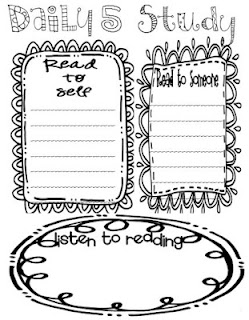
Nicole from Teaching with Style created this bookmark


Mel D from Seusstastic Classroom Inspirations creating note taking pages


Follow the following fabulous bloggers to get ready for the book study.


Thinking Out Loud


First Grade Blue Skies


Castles and Crayons


DillyDabbles

Fabulously First


Surfin' Through Second

So please grab of copy of this book and join us. 


Are you a kindergarten teacher?  Check out this Daily 5 Book Study just for you


Live Love Laugh


Are you an upper elementary teacher?  Check out this Daily 5 Book Study just for you


We Read, We Blog, We Teach